
A deck workmanship warranty is your builder’s written promise to fix faulty labor for a set number of years. In NSW it sits on top of protections the law already gives you: six years for major defects and two years for everything else, whether or not your contract mentions them. The best warranty is one that runs longer than the legal minimum, is written down clearly, and comes from a builder who stays accountable for the whole job. Ours runs for 10 years.
This guide explains the three layers that protect a Sydney deck (statutory warranties, consumer guarantees and the builder’s own warranty), what to look for in the wording, and what to do if a problem appears.
TL;DR
- A workmanship warranty covers the quality of the labor. Materials such as boards and fixings are covered by the manufacturer’s product warranty.
- In NSW, statutory warranties last six years for major defects and two years for other defects, counted from completion, and they apply even if the contract is silent.
- A builder’s warranty is an extra promise. It cannot reduce your legal rights, so a longer one is a genuine bonus.
- A written warranty should state its length, what the builder will do, how to claim and who pays claim costs.
- Our workmanship warranty on deck builds is 10 years, and every project is overseen by Tony.
Table of Contents
- What a deck workmanship warranty actually means
- The three layers of protection on a Sydney deck
- How long does the protection last?
- Contract rules that shape your warranty
- What to look for in a written warranty
- Why the builder behind the warranty matters
- Compliance: the part of workmanship you can check on paper
- If something goes wrong: a practical sequence
- A change on the way
- Our 10-year workmanship warranty
- FAQ
- Sources
What a deck workmanship warranty actually means
A workmanship warranty is about how the deck was built, not what it was built from. It speaks to things like how the frame was set out, how the boards were fixed, whether the stairs and balustrade were installed correctly and whether the deck drains and sits as designed. If a fixing fails or a joint opens because of the way the work was done, that is a workmanship matter.
Materials are a separate promise. Composite boards from brands such as Trex, Millboard or TimberTech carry the manufacturer’s own product warranty, and that is a different document with its own terms. A deck can have a strong product warranty and a weak workmanship warranty, or the reverse, so look at both.
NSW Government guidance describes a warranty as a voluntary promise from the business that becomes enforceable once you buy the service. It operates in addition to your consumer guarantees under the Australian Consumer Law (ACL), the national law that sets minimum standards for goods and services, and it cannot take them away.
The three layers of protection on a Sydney deck
Most homeowners only see the builder’s warranty in the paperwork. Behind it, two more layers already apply.
| Layer | Where it comes from | What it gives you | How long |
|---|---|---|---|
| Statutory warranties | Home Building Act 1989 (NSW) | Promises about care and skill, materials, plans and compliance | 6 years major defects, 2 years other defects |
| Consumer guarantees | Australian Consumer Law | Services done with acceptable care and skill, within a reasonable time | No fixed term; usually continue after a warranty expires |
| Builder’s workmanship warranty | The builder’s own promise | A written commitment to rectify faulty work | Set by the builder |
Statutory warranties
For residential building work, the law deems certain promises to be made by the builder to the owner. HIA notes these apply to work over $5,000 in NSW, cannot be excluded or restricted, and may pass to future owners. NSW Government guidance lists what they cover:
- work done with due care and skill, in line with the plans and specifications in your contract
- suitable materials that are new, unless the contract says otherwise
- work that complies with the law
- work done with due diligence and within the agreed time
- a dwelling that is reasonably fit to live in, where that applies
The NSW Government also confirms that these protections cannot be overridden by a contract and stay with the home if it is sold during the warranty period. A clause saying “no warranties apply” would not hold up.
Consumer guarantees
The ACL requires services to be carried out with an acceptable level of care and skill, at least as good as a competent person with average skills and experience, and within a reasonable time when no date was agreed. NSW Fair Trading points out that a warranty against defects is usually time-limited, but the consumer guarantees usually keep applying after the warranty expires. So the end of a workmanship warranty is not the end of your rights.
For a service failure that can be fixed, the provider may repair, redo or refund at no cost to you. If it refuses or takes too long, you may have the problem fixed elsewhere and recover the reasonable cost. For a major failure you may cancel and seek a refund, or keep the contract and negotiate a lower price.
The builder’s own warranty
This is where builders differ. Some offer a year or two, which largely mirrors the legal minimum for minor defects. Others commit to far longer. A 10-year workmanship warranty, which is what we give on our deck builds, runs well past the two-year statutory period for non-major defects and past the six-year period for major ones.
How long does the protection last?
The clock starts at completion, not at discovery. Six years applies to major defects and two years to all other defects.
What counts as major? Building Commission NSW describes a major defect as one in a major element of the building caused by defective design, workmanship or materials, or by failure to meet the structural requirements of the National Construction Code. Load-bearing parts such as foundations, footings, floors, walls, roofs, columns and beams are examples, as are fire safety systems and waterproofing. On an elevated deck attached to a house, the frame, footings and the connection to the wall are the parts that matter most.
Two timing rules are worth knowing:
- For contracts signed on or after 1 February 2012, if a loss becomes apparent in the last six months of the warranty period, you get a further six months after it ends to enforce the warranty.
- You are responsible for applying to the NSW Civil and Administrative Tribunal (NCAT) before the warranty period expires. Building Commission NSW advises that if the period is close to ending, you should lodge an NCAT application to preserve your rights.
A worked example
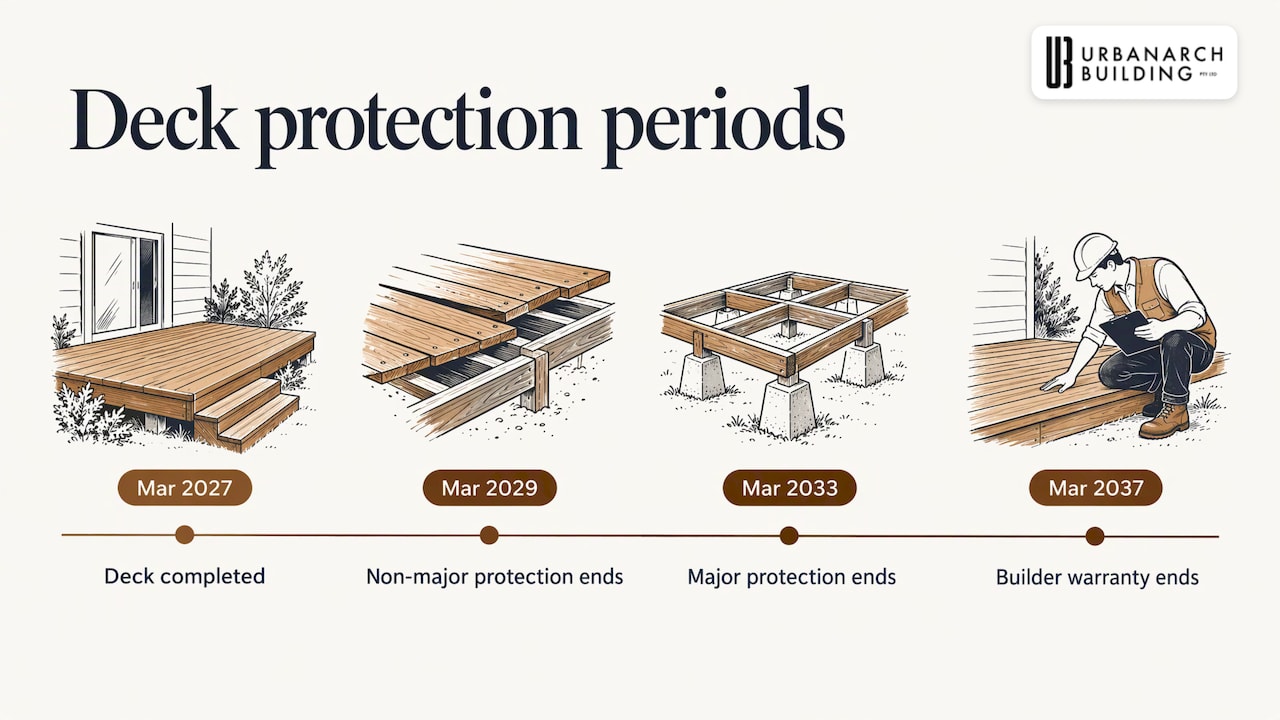
Say your deck is completed in March 2027. A board fixing pattern fails and boards lift in early 2028. That is a non-major defect, so the statutory two-year period runs to March 2029, and you have a claim. A frame problem that threatens the deck’s structure would be a major defect, with protection to March 2033. Under a 10-year builder warranty, the builder’s own promise would run to March 2037 on the labor side. Three different clocks, all starting on the completion date, which is why you should record it.
Contract rules that shape your warranty
In NSW, residential building work priced over $5,000 including GST needs a written contract. For jobs over $20,000, the rules get stricter: a large job contract with a five-clear-business-day cooling-off period, a progress payment schedule and a home warranty insurance certificate. Most custom decks, stairs and balustrade packages in Sydney land in the range where a written contract is required, and many will sit above $20,000.
To give you a sense of scale, our published pricing for composite decking runs from $905 to $1,355 per m², depending on the board (for example Woodevo Home at $905 to $995 per m², TimberTech Azek Vintage at $1,232 to $1,355 per m²). Treated pine decking is $915 to $965 per m², and Australian hardwood is $980 to $1,239 per m². A 30 m² deck therefore comfortably passes the $20,000 line. Your contract is where the warranty belongs, and the contract is the first document to read closely.
NSW also describes a defects liability period in many building contracts. HIA notes this is often 13 weeks after practical completion, used for minor issues such as small adjustments. It is a short-term fix-up window and is separate from, and does not shorten, the statutory warranties.
What to look for in a written warranty
A written warranty against defects has to meet a few requirements. NSW Fair Trading’s guidance for businesses says the document must state that the warranty operates in addition to your ACL rights, and the NSW Government lists what it should contain: what the business will do, the conditions for claiming, the business and contact details, how long it lasts, where to send a claim, and who pays claim expenses.
Use that as your checklist when you review any deck warranty:
- Length. Is the number of years stated, and does it say when it starts? The best answer is “from the date of completion”.
- The promise. Does it say the builder will repair or redo faulty work? Vague wording such as “we will do our best” is not a promise.
- How to claim. A named address, email or phone number, and what to include in your notice.
- Who pays. Claim-related costs should be clearly assigned.
- Your rights. A line confirming the warranty is in addition to your legal rights.
- Who stands behind it. A warranty is only as good as the person giving it. A builder who is on site, answers the phone and has a track record is worth more than a long number on paper.
Be careful about warranties that stretch to extreme lengths with long lists of exclusions. A written promise is worth what it will deliver, so read the conditions as carefully as the headline number.
Common exclusions in decking, and why they matter
Warranties usually draw a line between faulty workmanship and ordinary wear or later changes. Typical examples are damage from impact, pool chemicals or cleaning products, modifications by someone else, and a lack of normal upkeep. Timber needs periodic oiling or sealing, and composite boards need cleaning. Upkeep rules are reasonable, because they keep the deck in the condition the builder handed over. Ask for the maintenance expectations in writing when you sign, and keep records of when you do them.

Why the builder behind the warranty matters
A long warranty only helps if the builder is still around, still reachable and still checking the work that the warranty will rely on. That is why the structure of the business matters as much as the number of years.
UrbanArch is a father-and-son deck building company based in Sydney, with more than 20 years of combined experience. Tony prices each job and oversees the quality of every project, and a dedicated site supervisor is on the build. Our 4.8-star Google rating reflects how we work with clients from the first consultation to the final inspection. When the same people price, build and sign off a deck, a warranty claim goes to people who know the job.
For more on choosing a builder, see how to choose deck builders in Sydney and why Sydney homeowners trust a timber deck builder.
Compliance: the part of workmanship you can check on paper
Workmanship includes whether the deck meets the building rules. NSW planning specifications refer to the National Construction Code for decks attached to an external wall. The conditions include a floor no more than 3 m above the supporting footing, no cantilever off the wall, and an imposed load not exceeding 2 kPa. Heavier loads, such as a spa, need engineered design, and the connection to the wall must be flashed where cladding is removed.
Whether your deck needs council approval depends on its height, size and your council’s rules. Smaller, low decks are often exempt, while larger or elevated decks may need a development application or a complying development certificate. A deck built without a required approval can create problems with the warranty, with insurance and when you sell. We guide clients through design, council approvals and compliance, so the paperwork is done as part of the build rather than left to you. You can see how that works on our council approvals and compliance page.
If something goes wrong: a practical sequence
NSW Government guidance suggests you inspect the finished project, notify the builder of concerns in writing and keep a copy. The same steps work for a later defect.
- Document it. Take dated photos and note when you first saw the problem.
- Write to the builder. Describe the issue and reference your contract and the completion date. Keep a copy. Written notice is also good practice under Section 18B of the Home Building Act, and the sooner the builder knows, the sooner they can fix it.
- Allow a chance to rectify. Giving the builder an opportunity to repair the work is the usual first step before any formal action.
- Mind the deadline. If the statutory period is nearing its end, lodge an NCAT application before it expires.
- Use the complaints route if needed. Building Commission NSW deals with building defect complaints, and for serious or unresolved disputes a lawyer is the right person to see.
A change on the way
Building Commission NSW’s August 2024 position paper on the draft Building Bill proposed keeping the six-year and two-year periods, adding a six-month pause extension where a breach appears in the final six months, and extending warranties to incidental and necessary work linked to the contracted work. It was a proposal. Until the law changes, the Home Building Act rules above apply, so check the NSW Government pages for the current position before relying on any new rule.
Our 10-year workmanship warranty
We build custom composite and timber decks, external stairs, balustrades, privacy screens and pergolas across Sydney, Wollongong and the Southern Highlands, and every deck build comes with a 10-year workmanship warranty. It sits alongside your statutory warranties and consumer guarantees, so you hold all three at once.
If you are comparing quotes, put the warranty wording next to the price. Our composite decking and timber decking pages show published per-m² prices, and you can reach us through urbanarchbuilding.com to talk through your design, approvals and the warranty terms for your project.
FAQ
What does a workmanship warranty mean?
It is a builder’s promise to correct faulty labor for a stated period. It covers how the work was done, such as framing, fixing and installation, rather than the boards or hardware themselves, which carry the manufacturer’s warranty. It works alongside your legal rights and cannot reduce them.
How long is the builder’s warranty in NSW?
Statutory warranties last six years for major defects and two years for other defects, counted from completion. Many builders add their own written warranty on top. Ours is 10 years on deck builds.
Does my warranty end when the builder’s warranty expires?
No. A builder’s warranty is usually time-limited, but consumer guarantees under the Australian Consumer Law usually continue after it ends. Statutory warranties also run to their own deadlines regardless of what the builder offers.
Does the warranty transfer if I sell the house?
NSW statutory warranties stay with the home if it is sold during the warranty period. Keep your contract, completion date, photos and any written warranty together so a buyer can see them.
What should I do before signing a deck contract?
Check that the contract is in writing, that the warranty length, claim process and contact details are stated, and that any approvals are covered. For jobs over $20,000, expect a cooling-off period and a home warranty insurance certificate.
Sources
- Warranties, NSW Government
- Contracts for residential building work, NSW Government
- How to make sure your new building work remains trouble-free, NSW Government
- Receipts and warranties for businesses, NSW Government
- Consumer guarantees: a guide for consumers, ACCC
- Consumer guarantees guide, consumer.gov.au
- How Building Commission NSW deals with building defect complaints
- Resolving building disputes with your builder, NSW Government
- Statutory warranties for home building work in NSW, HIA
- Specification of Building Works, NSW Planning Portal
- Consumer protections for home building work, Building Commission NSW position paper